The Real World Stoic
Essays and meditations that put the Stoic teaching of Marcus Aurelius, Seneca and Epictetus to work in modern life — work, family, the body, money, technology and mortality.
Paperback and Kindle (Amazon KDP) · coming soon. [AMAZON LINKS + ISBN TO ADD AT LAUNCH]
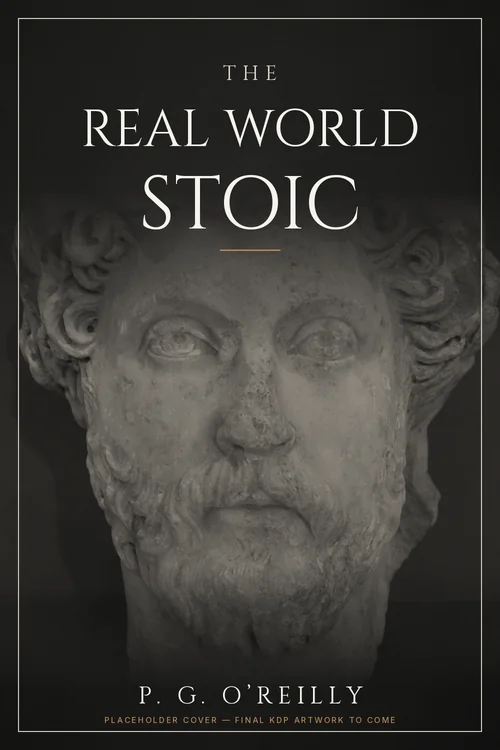
[PLACEHOLDER COVER — replace with final KDP cover]
Why Stoicism matters now
Stoicism is not an antique philosophy for scholars; it is a manual for endurance in the age of excess. It reminds us that peace cannot be downloaded, discipline cannot be outsourced, and character cannot be automated.
The Real World Stoic is a return to this clarity — not to withdraw from life, but to live it fully, awake and unafraid. It calls for strength without cruelty, courage without noise, and self-mastery without ego.
How to read it
- “This book is a forge, not a lecture. You don’t read it; you train in it.”
- “You can start this book anywhere. It is not a story. It is a system.”
- “Every page is a mirror and a weapon — something to hold up to your habits and sharpen your will.”
The chapters weave the ancient voices together with the realities of modern life — and each one ends in short, numbered meditations: single lines written to be remembered and used.
The fourteen sections
- SECTION I
The Line of Control
What we can and cannot control.
- The Stoic foundation (Epictetus, Marcus, Seneca).
- Everyday examples: flight delays, sport, business, family life.
- SECTION II
Time and Mortality
Memento Mori: remember death, live with urgency.
- Seneca on time as the greatest wealth.
- Marcus on mortality as motivation.
- Why procrastination is self-betrayal.
- SECTION III
Discipline and the Body
Training as philosophy.
- Boxing, martial arts, daily physical rituals.
- Sobriety and Stoicism: alcohol and drugs as the enemies of clarity.
- SECTION IV
Food, Fasting, and Restraint
Mastering appetite before appetite masters you.
- Seneca on voluntary poverty.
- Modern dangers: sugar, processed foods, supplements misuse.
- SECTION V
Heat and Cold
The Stoic art of choosing hardship.
- Ancient Stoics on cold baths, simple living.
- Cold exposure and resilience.
- SECTION VI
Emotions and Mastery
Response vs. reaction.
- Epictetus on insults.
- Marcus on cruelty and arrogance.
- Stoic reframing of anger, fear, jealousy.
- SECTION VII
Focus and Attention
Guarding the mind in the age of distraction.
- Social media and cheap dopamine.
- Reclaiming time through removal, not addition.
- SECTION VIII
Action and Ambition
Raw action solves all.
- Marcus Aurelius: stop talking, act.
- Ambition without attachment.
- SECTION IX
Family, Love, and Legacy
The Stoic parent, partner, and leader.
- Marcus as a father and emperor.
- Parenting by example, not lecture.
- Building a legacy of virtue.
- SECTION X
Wealth and Work
Money as tool, not master.
- Seneca on wealth and simplicity.
- Modern entrepreneurship, setbacks, freedom through work.
- SECTION XI
Adversity and Resilience
Using hardship as fuel.
- Seneca’s exile, Marcus’s plague, Epictetus’s slavery.
- Resilience as a trained response.
- SECTION XII
Virtue as the Only Good
The Stoic definition of success.
- Courage, justice, temperance, wisdom.
- Indifferents: wealth, fame, pleasure.
- SECTION XIII
The Stoic Life in Practice
Daily structure of a Stoic in the modern world.
- Morning: reflection and visualisation.
- Evening: journaling and review.
- SECTION XIV
Stoicism and AI: The Modern Ally
The future of discipline in a digital age.
- AI as “indifferent”: tool or master.
- Dangers: distraction, dependency, novelty addiction.
Section titles and summaries from the manuscript’s table of contents. [AUTHOR TO CONFIRM against final edition]
When the noise finally stops
The day I began writing this book was not calm.
It was loud — the kind of loud that comes from inside you. Emails stacking up. Notifications. A mind replaying everything you haven’t yet done. The hum of the world that never sleeps, never slows, never lets you breathe.
I remember standing at the sink, exhausted after a twelve-hour day that I couldn’t even describe as hard, only endless. The kind of day that makes no memory, only residue. I stared into the mirror, and for the first time in years, I didn’t recognise the man looking back. He wasn’t weak. He wasn’t broken. But he wasn’t alive either. He was functioning — an efficient ghost.
That was the night I found Marcus Aurelius again. I didn’t discover him — I returned to him.
[…]
That night, I began to rebuild. Not my business. Not my brand. Myself.
P. G. O’Reilly
P. G. O’Reilly is a Northern Irish writer, entrepreneur, and modern Stoic whose work bridges ancient philosophy and the demands of contemporary life. A planning consultant and lifelong student of human discipline, he has spent two decades balancing business, family, and personal mastery.
From boardrooms to training fields, he has tested Stoicism in the real world — learning that peace is not found in retreat but in clarity, courage, and consistency.
Be first to know when it’s out
Join the free daily email and you’ll hear the day the paperback and Kindle editions go live.